
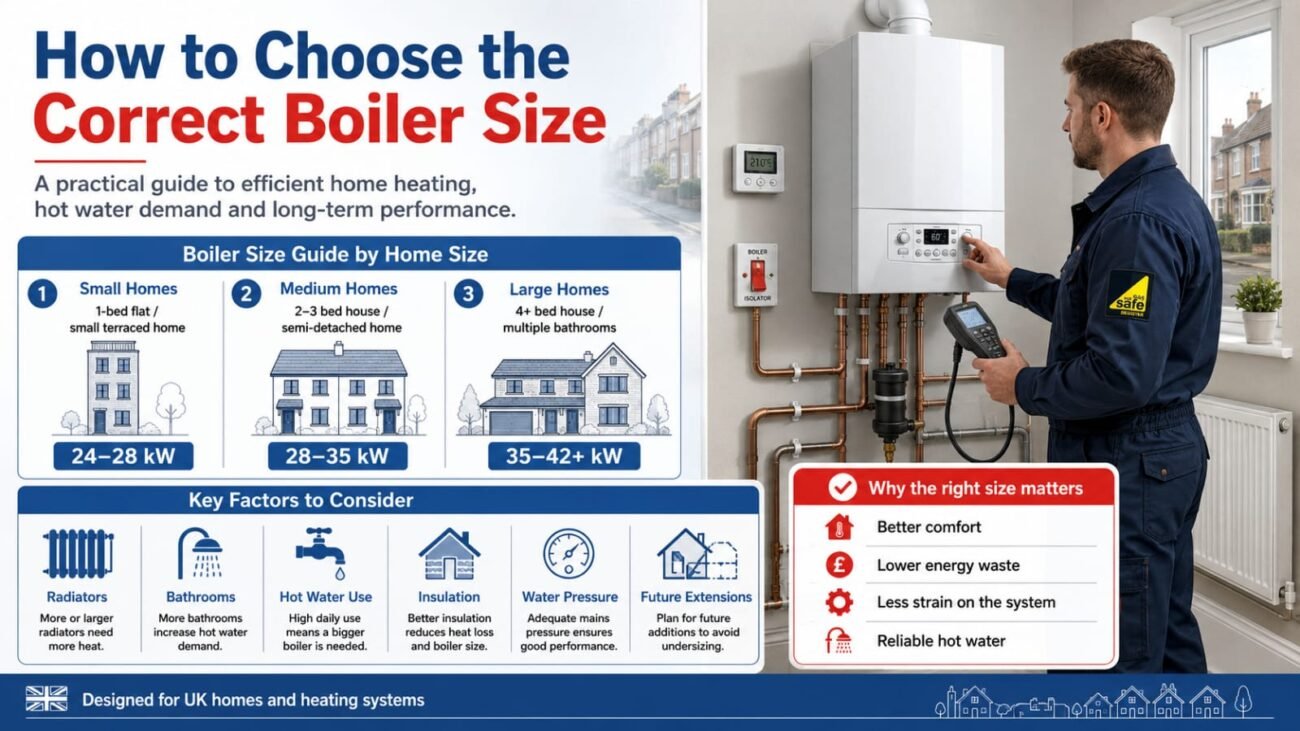
Learn how boiler size affects heating performance, hot water demand, energy bills and long-term reliability, with practical guidance for choosing the right output for your home.
Selecting a new boiler is not simply a matter of choosing the most powerful model available. The right boiler must be carefully matched to the size of the property, the number of radiators, the household’s hot water demand, the condition of the pipework and the level of insulation. Many homeowners search for What Size Boiler Does Your Home Need? because an incorrectly sized boiler can affect comfort, efficiency and long-term running costs.
A boiler that is too small may struggle to heat rooms properly during colder months, while a boiler that is too large may waste energy by switching on and off more often than necessary. Both situations can reduce efficiency and place avoidable strain on the heating system.
Correct boiler sizing helps create a balanced system. It allows the boiler to provide reliable heating and hot water without excessive fuel use, unnecessary cycling or poor performance. This is especially important in homes where radiators, controls or pipework have been upgraded gradually over time.
The best boiler choice depends on how the property is actually used. A small flat with one bathroom has very different heating requirements from a larger family home with several bedrooms, multiple bathrooms and regular hot water demand throughout the day.
Why Boiler Size Matters More Than Many Homeowners Realise
Boiler size is measured in kilowatts, usually written as kW. This figure shows how much heat output the boiler can produce. The higher the kW rating, the more heating capacity the appliance can deliver. However, a higher number does not automatically mean a better result.
An oversized boiler may heat the system quickly and then shut down before the radiators have distributed heat evenly. This short cycling can increase wear on components, reduce efficiency and create inconsistent comfort levels. In some cases, it can also lead to more frequent repairs over the lifetime of the appliance.
An undersized boiler creates the opposite problem. It may run for long periods while failing to reach the desired temperature. Hot water may fluctuate, radiators may warm unevenly and the home may feel uncomfortable during winter. For households with regular shower use, the wrong boiler output can also cause weak or inconsistent hot water delivery.
Proper sizing improves heating response, helps reduce wasted energy and protects the boiler from avoidable stress.
Understanding Boiler Output and Real Heating Demand
Boiler output should be based on the heating load of the home rather than a rough guess. The number of bedrooms is useful as a starting point, but it does not provide enough detail on its own.
A professional heating assessment will usually consider the number and size of radiators, the number of bathrooms, the hot water habits of the household, the level of insulation, window quality, water pressure, pipework condition and future plans such as extensions or additional bathrooms.
Two properties with the same number of bedrooms can need different boiler outputs. A well-insulated modern flat may need much less heating power than an older property with draughts, single glazing or inefficient radiators.
Hot water demand is particularly important when choosing a combi boiler because the appliance must heat water instantly as it passes through the unit. If several outlets are likely to be used at the same time, the boiler must be able to support that demand.
Boiler Types and How They Affect Sizing
The correct boiler size also depends on the type of boiler being installed. The three main domestic options are combi boilers, system boilers and conventional boilers. Each one handles heating and hot water differently.
Combi boilers provide central heating and hot water from one compact unit. They are popular in flats and smaller homes because they do not usually require a hot water cylinder or cold water storage tank. Their sizing often depends strongly on hot water flow rate as well as radiator demand.
System boilers work with a hot water cylinder. They are often suitable for larger homes or households where several people may need hot water at similar times. The boiler output must be matched to both the radiator circuit and the cylinder requirements.
Conventional boilers, also known as regular or heat-only boilers, are often found in older or larger properties. These systems may include storage tanks and traditional pipework layouts, so sizing requires careful assessment of the wider heating system.
Typical Boiler Sizes for Small Homes
Small homes usually require lower boiler output because they have fewer rooms, fewer radiators and lower hot water demand. This may include one-bedroom flats, compact apartments, small terraced homes and properties with one bathroom.
For many smaller properties, a combi boiler in the region of 24kW to 28kW may be suitable, depending on the hot water requirement and mains flow rate. These models can often provide efficient heating without being unnecessarily powerful.
However, even a small property should not be assessed by size alone. If the home has poor insulation, older radiators or unusually high shower usage, the final recommendation may change. A compact boiler should still be properly matched to the property rather than chosen only because it fits the available space.
Typical Boiler Sizes for Medium Homes
Medium-sized homes often need a higher output because they contain more radiators and may have greater hot water usage. This category often includes two or three-bedroom houses, larger terraced properties and family homes with one or two bathrooms.
A boiler between 28kW and 35kW may be suitable for many medium properties, but the final choice depends on occupancy and daily routines. A household with several people showering in the morning may require stronger hot water performance than a similar property occupied by fewer people.
For medium homes with two bathrooms, the decision between a larger combi boiler and a system boiler should be considered carefully. If simultaneous hot water use is common, stored hot water may sometimes provide better comfort than relying purely on instantaneous supply.
Typical Boiler Sizes for Large Properties
Larger homes require a more detailed calculation because the heating system may need to serve several floors, multiple bathrooms and a larger number of radiators. Detached homes, extended properties and houses with loft conversions often fall into this category.
A boiler output of 35kW to 42kW or more may be needed in some larger homes, depending on radiator demand and hot water usage. However, output should never be selected without checking the existing system layout, water pressure and pipework.
In many larger households, a system boiler with a correctly sized hot water cylinder can offer stronger performance than a combi boiler. This is especially useful where baths, showers and taps may be used at the same time.
Large properties also benefit from zoning controls, balanced radiators and efficient thermostatic valves, as these help distribute heat more effectively and reduce waste.
The Role of Insulation, Radiators and Pipework
Boiler sizing should not be viewed in isolation. A new boiler can only perform properly if the rest of the heating system supports it. Insulation, radiators, pipework and controls all affect the final result.
A well-insulated home retains heat for longer, reducing the workload on the boiler. Improvements such as loft insulation, draught proofing, better glazing and wall insulation can reduce heat loss and may allow the home to operate efficiently with a lower output boiler.
Radiator performance also matters. Old, undersized or internally blocked radiators may fail to heat rooms effectively, even when the boiler itself is powerful. Sludge and corrosion inside the system can restrict circulation and reduce efficiency.
Pipework should also be checked before installation. Older systems may have sections that restrict flow, reduce pressure or make it difficult for the boiler to perform as intended.
Water Pressure and Flow Rate for Combi Boilers
For combi boilers, mains water pressure and flow rate are critical. A high-output combi boiler cannot deliver strong hot water if the incoming water supply is weak.
Before installing a combi boiler, the engineer should test how much water the property can realistically supply. If the flow rate is too low, choosing a larger boiler may not solve the problem. In that situation, a system boiler with a cylinder may be a more suitable option.
This is particularly important in homes with more than one bathroom, larger showers or frequent hot water use. Good hot water performance depends on both boiler capability and the water supply feeding it.
Warning Signs Your Existing Boiler May Be the Wrong Size
Many homeowners only discover sizing problems after living with poor heating performance for several years. Some symptoms may suggest that the current boiler no longer suits the property.
Common warning signs include radiators taking too long to heat, rooms warming unevenly, hot water running cold, repeated boiler cycling, rising energy bills, frequent breakdowns, noisy operation and poor winter performance.
These issues do not always prove that the boiler is incorrectly sized. They may also be caused by sludge, faulty controls, poor circulation, air in the system or ageing radiators. However, they are strong reasons to arrange a professional heating inspection before choosing a replacement.
Planning for Future Property Changes
Boiler selection should also take future improvements into account. If the property may be extended or a new bathroom added, the heating demand could increase significantly.
Future changes that may affect boiler sizing include loft conversions, kitchen extensions, extra bedrooms, additional bathrooms, underfloor heating, larger radiators and increased household occupancy.
Choosing a boiler only for the current layout may create problems later if the home changes. A balanced recommendation should consider both present requirements and realistic future demand.
Why Professional Boiler Calculation Is Essential
Boiler sizing should be based on proper assessment rather than guesswork. A professional engineer can check heat loss, radiator demand, hot water usage, water pressure, gas supply, flue options, pipework condition and control compatibility before recommending an appliance.
This approach helps avoid underpowered systems, oversized boilers, poor hot water performance and unnecessary running costs. It also ensures the new boiler works safely and efficiently within the property’s existing infrastructure.
For homeowners looking for Expert Boiler Installation, Repairs & Servicing in Fulham, a detailed survey can help identify the correct boiler output, suitable system type and any improvements needed to achieve reliable long-term performance.
Quick Boiler Sizing Comparison
| Property Type | Typical Demand | Common Boiler Option | Key Consideration |
| Small flat or apartment | Low heating and one bathroom | 24kW to 28kW combi boiler | Check mains flow rate and available space |
| Medium family home | Moderate radiator and hot water use | 28kW to 35kW combi or system boiler | Assess number of occupants and bathrooms |
| Large house | High heating and multiple outlets | 35kW+ system boiler may be suitable | Cylinder size and zoning may be important |
| Extended property | Demand may increase over time | Calculated individually | Allow for future bathrooms or extra rooms |
Final Thoughts
Choosing the correct boiler size is one of the most important parts of creating an efficient and reliable heating system. The right appliance should match the property’s heating load, hot water demand, insulation level, radiator capacity and future plans.
A boiler that is too small may leave the home uncomfortable, while an oversized system may waste energy and increase mechanical wear. The most efficient result comes from selecting a boiler that is powerful enough for real demand without being excessive.
Small properties often suit compact combi boilers, medium homes require careful assessment of hot water usage, and larger homes may benefit from system boilers with stored hot water. With accurate calculation and professional installation, homeowners can improve comfort, reduce energy waste and protect the heating system for years to come.
